
Edmonton area profile
West Edmonton
Covers the west end west of 170 Street — Callingwood, the West Edmonton Mall area (Summerlea), and the river-valley west (Cameron Heights, Wedgewood).
West Edmonton groups 18 Edmonton neighbourhoods — about 19,245 homes, 61.9% houses and 38.1% condos. The typical (median) house is assessed around $482,500, 2% above the citywide median; condos around $204,500. Across its established houses, the median assessed value changed +25% from 2012 to 2026. 68% of homes are owner-occupied, the average household income is about $121,395. Area figures are averages and City assessed values — directional, not sale prices ("typical" means the median; averages are noted as such).
“West Edmonton” follows the City of Edmonton's official West Edmonton planning district — one of 15 the City uses to group its 300+ neighbourhoods. Figures roll up the City's 2026 assessed values and the 2021 federal census across the area's neighbourhoods. Where a median can't be combined across neighbourhoods (income, age, shelter), the page shows the average instead — so those read higher than the medians on the neighbourhood pages and aren't directly comparable.
Neighbourhoods
18
profiled in this area
Total homes
19,245
61.9% houses · 38.1% condos
Typical house
$482,500
2% above citywide
Typical condo
$204,500
1% below citywide
House $/sq ft
$286
10% below citywide
Condo $/sq ft
$207
level with citywide
Typical lot
6,361 ft²
21% above citywide
Avg. household income
$121,395
2021 · average, not median
Where it is
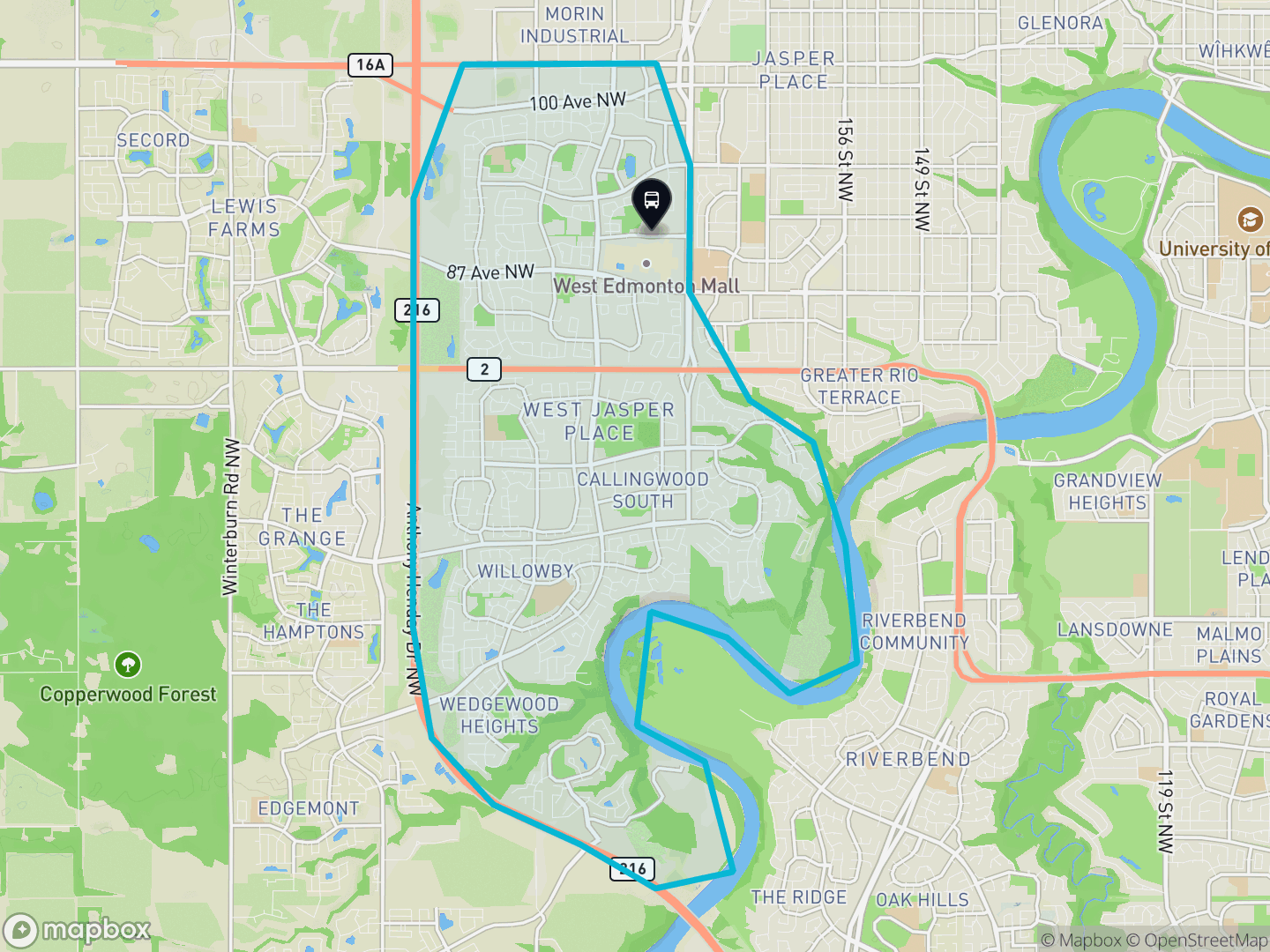
At a glance. West Edmonton and its boundary, with LRT and transit centres marked — green areas are parks and open space.
Stay in the loop
Get the Edmonton market update
My monthly read — what's selling, where prices are headed, and what it means.
The homes
What's here, when it was built, and the condo & rental stock — rolled up across the area's neighbourhoods.
What's here
Mostly houses. 61.9% houses · 38.1% condos.
Built-form mix & bedrooms (2021 census · 117% coverage)
When it was built
Most homes here were built in the 1980s. The median build year is 1985.
Building age, by decade
Condos & multi-family
Condos are 38.1% of homes — most in Callingwood South, Terra Losa and Ormsby Place. Plus 63 purpose-built rental buildings.
How the condo & rental stock breaks down
- Callingwood South1,279 condos
- Terra Losa1,173 condos
- Ormsby Place718 condos
- Callingwood North670 condos
Across roughly 116 condo developments, the largest about 224 units. Separately-titled parking and storage aren't counted as homes.
63 rental / multi-family buildings, typically built around 1987 — 2 small (under $1M), 24 mid ($1–10M), 37 large (over $10M). Purpose-built rentals (assessed as single parcels), separate from the owned homes; unit counts aren't in the open data.
Living here
Who lives in the area, what housing costs, and the schools, shopping, transit and parks across the district.
Who lives here
Mostly homeowners. Average household income $121,395, average age 40.7.
Income, age and household size are averages (these combine exactly across neighbourhoods, where a median can't) — so they read higher than the medians shown on the neighbourhood pages. The distribution shares below are exact counts.
Income, households, ages, work & mobility
Household income (45% earn $100k+)
Households (average 2.6 people)
Ages (average 40.7)
Work — occupations
Work — industries
39% of residents moved here within the last 5 years (13% within the last year).
Origins, immigration & religion
67% born in Canada · 32% immigrants · 1% non-permanent residents.
Most commonly reported origins (multiple responses allowed — shares overlap)
Population groups
36% of residents identified as a visible minority; 64% did not. Separately, 7% identify as Indigenous.
StatCan defines a "visible minority" as "persons, other than Aboriginal peoples, who are non-Caucasian in race or non-white in colour" (Employment Equity Act) — so Indigenous residents are counted separately, and the "not a visible minority" share is predominantly residents who identify as white.
Religion
Immigration, ethnocultural origin, population group and religion from the 2021 federal census, summed across the district's neighbourhoods. Neutral Statistics Canada classifications, shown identically for every area.
Housing costs
Owners pay about $1,557/month; renters about $1,366/month. Average monthly shelter cost, 2021.
Schools
17 schools across West Edmonton — 11 public · 6 Catholic. Senior highs: St. Oscar Romero.
Schools by level & senior highs
Counts schools located in the district (a school offering several levels is counted in each). Public = Edmonton Public, Catholic = Edmonton Catholic. Fraser Institute rankings → · private/independent schools aren't in the City's open data.
Shopping
Major shopping centres here: Terra Losa / West End Power Centre, West Edmonton Mall.
Edmonton's major malls and power centres located in this district. Everyday retail (groceries, pharmacies, services) is spread across the neighbourhoods.
Transit
1 transit centre serve the area; no LRT here yet.
LRT stations & transit centres
Transit centres: West Edmonton Mall Transit Centre.
Parks & green space
47 parks covering about 477 hectares, including 8 natural areas and river-valley / ravine greenway.
The largest parks
- Centennial Valley78 ha
- Cameron Heights Park #60 ha
- River Valley Terwillegar Park 142 ha
The market
How assessed values have moved, and how much has been built.
Assessed value over time
The median assessed house value changed +25% from 2012 to 2026.
Established houses — largely the same properties over time, so this mostly reflects real value change.
Building activity
Since 2015: 3,352 building permits and 595 net new units, plus 91 secondary suites.
Permits, units & suites year by year
Permits count every new home — including purpose-built rental and mixed-use buildings — so the yearly units can run above the owned house/condo count above. “Units” are net of demolitions, so a redeveloping year can read negative; “suites” are secondary-suite permits (basement / garden / garage suites).
The neighbourhoods
Every neighbourhood in West Edmonton, sorted by number of homes — each links to its full data-driven profile.
- Lymburn 2,072 homes · typical house $409,000
- Ormsby Place 1,759 homes · typical house $504,000
- La Perle 1,637 homes · typical house $434,500
- Aldergrove 1,593 homes · typical house $440,500
- Jamieson Place 1,385 homes · typical house $472,000
- Belmead 1,348 homes · typical house $443,500
- Callingwood South 1,279 homes
- Terra Losa 1,173 homes
- Oleskiw 1,082 homes · typical house $766,500
- Callingwood North 799 homes · typical house $389,500
- Cameron Heights 797 homes · typical house $709,000
- Gariepy 746 homes · typical house $551,250
- Thorncliff 735 homes · typical house $403,000
- Donsdale 607 homes · typical house $822,000
- Dechene 598 homes · typical house $529,000
- Summerlea 588 homes · typical house $455,000
- Westridge 526 homes · typical house $655,000
- Wedgewood Heights 521 homes · typical house $609,000
Source
City of Edmonton Open Data — property assessment & property information (2026 assessment roll), building permits; Statistics Canada 2021 Census of Population (City of Edmonton neighbourhood tabulation); area boundaries from City Plan Districts. Contains information licensed under the Open Government Licence – City of Edmonton. Demographics: Statistics Canada 2021 Census of Population (City of Edmonton neighbourhood tabulation). Area boundaries: City Plan Districts.
About these figures. Area figures roll up the City's 2026 assessment roll (its mass-appraisal estimate of market value as of July 1, 2025) and the 2021 federal census across this district's neighbourhoods — a directional, comparative signal, not the price a specific home would sell for. Income, age and shelter figures are averages (labelled), which read higher than medians and aren't directly comparable to the neighbourhood pages. Trevor Tardif is a licensed REALTOR® with REAL Broker AB Ltd, Edmonton, Alberta. Content on this site does not constitute financial or investment advice.
Zooming out: see the Edmonton economy — jobs, rents, vacancy and interest rates for the whole region.
Stay in the loop
Following West Edmonton? Get the bigger picture.
West Edmonton is one part of the city — but the forces that move its prices play out region-wide. That's what my market read tracks.
Weighing West Edmonton against another part of the city?
The profiles are the starting point. I'll run the comparison for your shortlist — what each area actually trades at, and which neighbourhoods fit what you're after — and walk you through it.